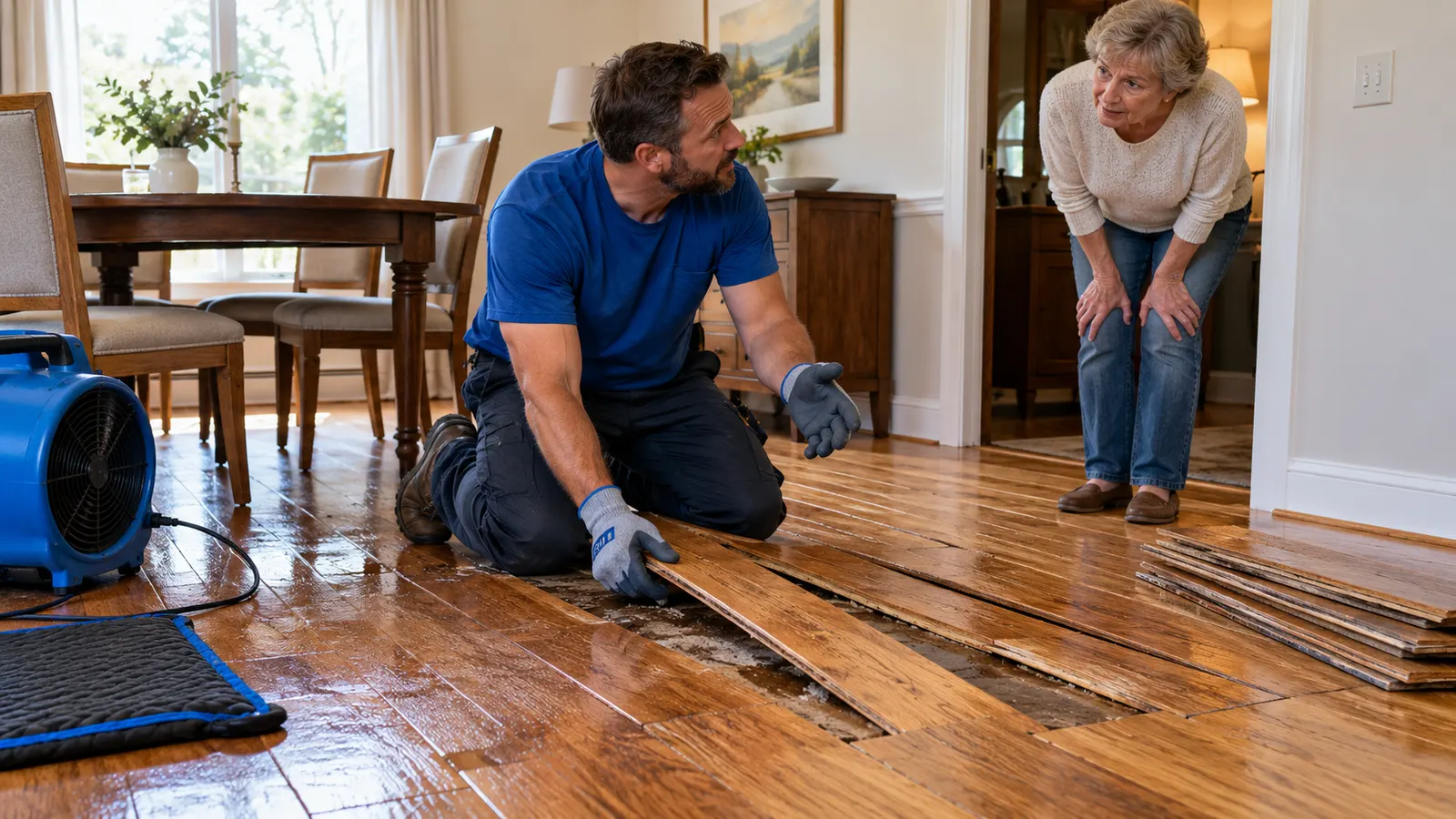
Carpet, Wood, and Subfloor Need Different Decisions
These layers do not necessarily recover together. A dry carpet face does not show dry pad, and a wood surface that looks flatter does not show the condition of its underside. Readings and accessible inspection support separate decisions about each part of the structure.
Signs That Water Reached Beyond the Puddle
Floor damage can show up at a transition or cabinet edge away from the source. Report those observations even if the center of the room looks unchanged. We use them to guide inspection rather than treating any single symptom as proof of a particular hidden condition.
- Hardwood edges that rise or cup compared with nearby boards.
- Soft or loose flooring near a doorway or appliance.
- Wet pad visible at an accessible carpet edge.
- Swollen baseboards or composite cabinet toe kicks.
- Dampness at a floor transition after surface extraction.
- A change in the floor below an attic or ceiling loss.
Water can travel beneath continuous flooring through more than one room. That does not mean every board must automatically be removed, but it does mean that the wet footprint needs checking beyond the point where the water first appeared.
Slab Moisture and Raised-Floor Conditions in Bixby
In slab homes, carpet pad and underlayment can hold water against concrete long after the open floor has been cleared. Existing ground-moisture conditions in river bottomland may also need distinguishing from the incident being restored. We ask whether the floor had earlier dampness or adhesive problems before the current loss.
Pier-and-beam construction adds another side to the inspection. The underside of a wood subfloor or nearby joists may be wet from a line beneath the house, even when the finished floor received little surface water. Restoration planning should connect those accessible observations without assuming that one layer describes the whole floor.
Oklahoma summer condensate overflows and winter attic-line failures can both reach flooring far below their source. Spring runoff introduces contamination concerns that change the retention discussion. The crew considers the water source together with material construction before deciding whether drying an installed finish is a reasonable approach.
What We Remove and What We Try to Dry
Removal for condition or access
Contaminated pad, delaminated flooring, damaged underlayment, and swollen composite material may need removal. Some openings are also needed to reach concealed water even when a visible surface appears intact. We explain which reason applies so the work record does not confuse damage with access requirements.
Drying sound remaining materials
Where the water condition and physical integrity allow retention, accessible substrate or framing may be dried with measured airflow and dehumidification. The plan needs a path for moisture to leave. A finish that blocks that path may have to be removed before the underlying structure can be checked effectively.
Before Sanding or Installing New Flooring
Refinishing or installing a new floor should follow the assessment of the structure beneath it. Sanding visibly cupped boards too early can create another problem if their moisture condition is still changing. We discuss drying records and remaining damage before the repair or flooring contractor proceeds.
Replacement planning also involves thresholds, matching concerns, and fixed cabinetry. Those are repair-scope questions rather than reasons to ignore moisture outside the original puddle. We record where materials were lifted or removed and which areas remained accessible for follow-up checks so the next trade understands what the cleanup exposed.
Documenting Each Affected Floor Layer
Photos of the visible finish, lifted layers, and exposed substrate help explain the flooring loss. We record moisture readings and drying logs for remaining materials, along with removal boundaries. Room names and transition locations make those records easier to connect to the proposed repair work.
We work with your adjuster on questions about the damage and scope. Matching allowances, coverage, and claim approval are decisions for the insurer under the policy. Keep any available flooring information, such as product names or earlier installation records, without assuming it establishes how the claim will be settled.
Wet Flooring Assessment Questions
Does cupping mean every hardwood board is beyond repair?
Not necessarily. The response depends on moisture conditions, board construction, physical damage, and access to the layers underneath. We assess those factors before discussing removal or drying. Appearance alone does not show either that the entire floor must go or that it can be retained.
Can new underlayment be laid over a damp substrate?
Covering the substrate can trap moisture and make later checks difficult. The exposed structure needs assessment before replacement layers are installed. We record drying progress and remaining physical damage so the installation discussion addresses the condition beneath the finish rather than only the new material.
Why remove pad when the carpet face looks usable?
Pad can retain water against the substrate, and contamination or prolonged saturation may make it unsuitable to keep. Carpet condition is assessed separately. The crew explains the reason for each layer's removal rather than assuming that a usable-looking face means everything beneath it is also suitable.
Do cabinets need checking after water reaches a kitchen floor?
Yes, accessible cabinet bases and toe kicks may conceal water or contain absorbent components. We inspect the route where possible and explain access limits. Removing floor water in front of the cabinets does not show that the area underneath them stayed dry.